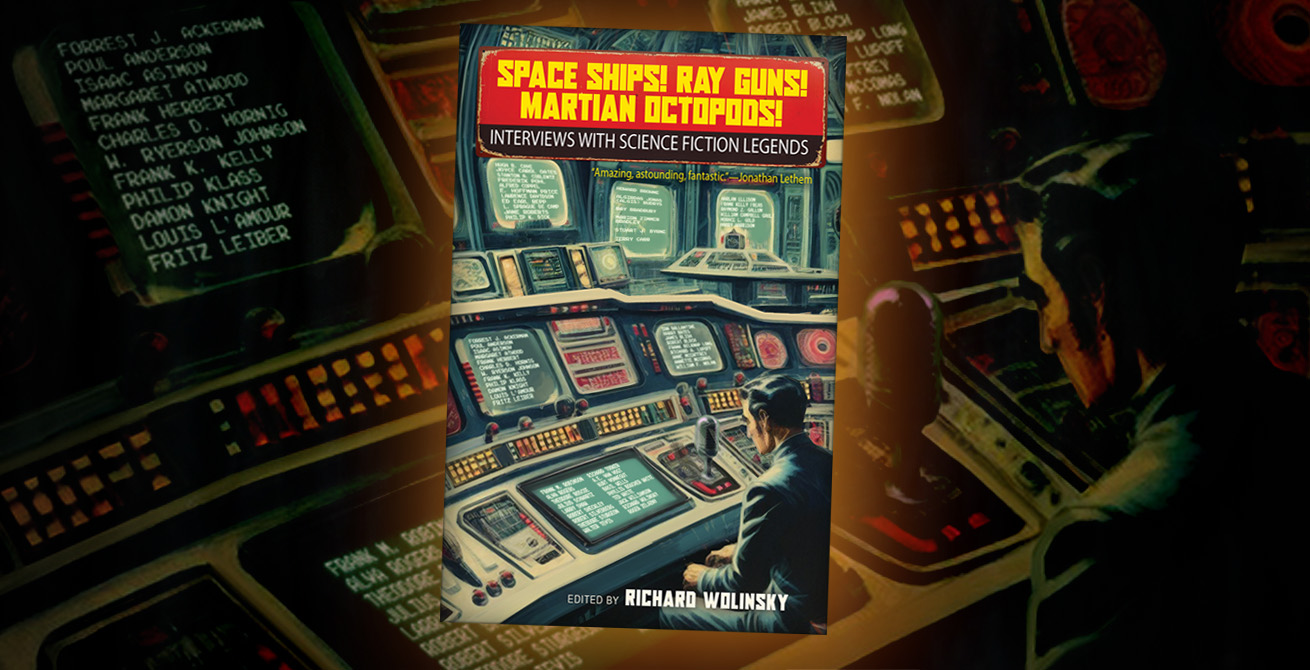
Richard Wolinsky co-hosted and produced Probabilities, a half-hour radio program devoted to science fiction, mystery, and mainstream fiction, from 1977 to 1995 on KPFA-FM. He took the program solo in 2002, renamed it Bookwaves, and it is still running. Along the way, he has spoken with most of the English-speaking world's leading authors, including Peter Carey, Joseph Heller, William Kennedy, Margaret Atwood, Anne Rice, Gore Vidal, James Ellroy, Joyce Carol Oates, Norman Mailer, Salman Rushdie, E.L. Doctorow, and many others. Wolinsky's interviews have been published in numerous venues, including the San Francisco Bay Guardian, Heavy Metal, Mystery Scene Magazine, and in such books as Feast of Fear: Conversations with Stephen King, The Louis L'Amour Companion, and Macabre II: Stephen King & Clive Barker. Wolinsky was born and raised in New York City and has lived in the San Francisco Bay Area since 1978. Space Ships! Ray Guns! Martian Octopods! is a collection created from interviews with Speculative Fiction authors on Probabilities and Bookwaves, and he recently talked about it with Daryl Maxwell for the LAPL Blog.
Both the Foreword by Richard A. Lupoff and your Introduction describe attempts that were made over the years to present the interviews conducted on Probabilities in book form, but they never worked out for various reasons. How did Space Ships! Ray Guns! Martian Octopods! finally come to fruition?
Twenty-five years ago, the book made the rounds; some of the editors liked it ("I'll buy it when it's published, but I won't publish it:") and others rejected it outright.
In 2019, I was approached by Jacob Weisman of Tachyon Books, pretty much out of the blue. He had worked out a deal with a Chinese publisher for the publication in Chinese of a previously published Tachyon book, a biography of Philip K. Dick by his daughter Anne. "Do you have any more non-fiction?" they asked. He remembered my book, contacted me, and asked if I'd like to see my book published—only in China and only in Chinese translation. I thought that was a hoot, said yes. Free money and a book in Chinese. Better than nothing. Then came the pandemic. In 2024, I was contacted again, and Jacob said the Chinese insisted upon an English-language publication prior to the Chinese one. And that's how it came into being.
In his Foreword, Richard A. Lupoff vividly describes his first exposure to science fiction pulps. Do you remember your first exposure to the genre?
I'd heard of pulp magazines, of course, but I think the first time I saw one was at the house of pulp collector and science fiction/thriller novelist Frank M. Robinson. Of course, little did I know that so many of the SF stories I'd read as a teenager had been first published in the pulps. My first science fiction reading, which made me a fan of the genre, came at fifteen when I read Anthony Boucher's Treasury of Science Fiction two-volume set, which was a gift from my uncle who at the time worked for the publisher. Those stories, which included "Waldo" by Robert Heinlein and "The Stars My Destination" by Alfred Bester, turned me into a fan of the genre. Again, I did not know their publishing history until over a decade later.
When/how did you decide on the format for the book (gathering comments from multiple subjects about a topic) rather than printing the interview(s) with specific subjects? What was your process for putting the book together in this way?
From the early days of Probabilities, I was the editor of our interviews for air. So I'd listened to all of them in their entirety. I knew instinctively that many would not have worked as full transcriptions—too much interrupting, questions that didn't produce the right answers, false starts, etc.—and also knew that each would have required almost as many footnote references as the length of the interviews themselves. That's when I decided to create topics and pick and choose the paragraphs that were usable. It was pretty much for fun. I didn't realize it might actually be a book until far along in the process.
Were there any surprises for you amongst the interviews you reviewed? Comments/opinions that were unexpected. Writers who had been interviewed that you may have forgotten?
At the time I did the work, which was in the 1990s, there wasn't much that was surprising. Today, as I go back and digitize the cassettes for podcasts and radio, there's a lot that I don't remember. But I don't recall being surprised back at the beginning because I'd been so meticulous with the original reel-to-reel tapes for. I knew the highlights as I transcribed.
Was there a writer, or writers, who appeared on Probabilities multiple times? If so, who appeared the most?
I am still doing the program. It's called Bookwaves in syndication and The Bookwaves Artwaves Hour on KPFA and as a podcast on kpfa.org. There's also a weekly podcast (dropping Sundays) at kpfa.org called Radio Wolinsky. It's hard for me to distinguish any of the authors over 45+ years from those who are in the book, were on Probabilities, or I interviewed after the program's name and later format change.
The writers who I’ve interviewed most are Margaret Atwood, Salman Rushdie, Peter Carey, Paul Theroux, Walter Mosley… Carl Hiaasen, Lisa See, James Ellroy, Jane Smiley, maybe Jonathan Lethem, Gore Vidal all come to mind. I'd have to count. But the first four names on the list stand out most.
Was there someone you didn't think would appear but did?
John Updike, Joseph Heller, Norman Mailer, Stephen Sondheim, Gore Vidal, John Dean, Bill Bradley, Margaret Cho, Carol Channing, Barbara Cook, John Barth, William Finn, Leonard Nimoy, Larry McMurtry, Michael York. If the author or actor or songwriter or playwright is alive, there's always a hope.
Someone you wanted but was never able to appear?
During the Probabilities years, a slew of them: Robert Heinlein, Leigh Brackett, C.L. Moore, Alfred Bester, Brian Aldiss, George Lucas are a few. Later on, there were Chita Rivera, Doris Lessing, Maya Angelou. Judy Lynn Del Rey. Obviously Thomas Pynchon, but even though he's still alive, that will never happen.
The book was supposed to have a different title, but was changed to Space Ships! Ray Guns! Martian Octopods!. Where/when in the process of working on the book did you settle on that name? (And what exactly are "Martian Octopods"?)
Credit goes to Tachyon. The original title of the book, "The Girl in the Brass Brassiere," based on a specific pulp cover, was no longer viable, and it was Rick at Tachyon who found the title in Dick Lupoff's introduction. To find out what Martian Octopods are, you'd have to have a séance and ask Dick Lupoff. You can find the original title, by the way, inside a footnote in Margaret Atwood's collection of essays, Writing with Intent.
Richard A. Lupoff passed in October of 2020 and is described in the book as working on and revising his Foreword for the book version of Probabilities interviews for years (with the last version, which is used in the book, having been written in 2019). What do you think his reaction would be to the book finally being published?
Thrilled. The Probabilities project, for him, particularly the search for the old editors and writers, was a labor of love. To see it finally published would have delighted him no end.
What do you think it is about Science Fiction and Fantasy that draws authors and/or readers to these types of stories?
I think it's always been the sense of wonder, the sense of imagination. I remember being gobsmacked at fifteen reading Bester’s The Stars My Destination in that Boucher collection. But all of those stories grabbed me. I urge anyone reading this to seek it out. The full title is A Treasury of Great Science Fiction. It's pretty much the ur-text for pre-Star Wars science fiction. The future was a lot more fun and held more promise in 1960 than in 2025.
What's currently on your nightstand?
The two books now are the two upcoming interviews, Dark Renaissance: The Dangerous Times and Fatal Genius of Shakespeare's Greatest Rival by Stephen Greenblatt, and Hatchet Girls, a Hap and Leonard novel by Joe R. Lansdale. Two books that are still there but I've had to put aside for interview reading are How Sondheim Can Change Your Life by Richard Schoch and Doppelganger by Naomi Klein.
If I ever get the time and take a break from interview reading, I also have The Secret Commonwealth by Philip Pullman, and Our Evenings by Alan Hollinghurst. There’s also Salman Rushdie’s most recent novel, Victory City.
Can you name your top five favorite or most influential authors?
Influence wanes over time, and often vanishes after the writer dies. I think my favorite authors, the people I would read, whether I could get an interview or not, were Gore Vidal, John Le Carre, Anne Rice, Elmore Leonard, Donald Westlake, and Isaac Asimov. They're all gone now.
What was your favorite book when you were a child?
Once I graduated from the Hardy Boys, it was Advise and Consent by Allen Drury and The Caine Mutiny by Herman Wouk, and The Wizard of Oz by L. Frank Baum. A couple of years later, they were joined by Julian by Gore Vidal. And the moment I found that first Ace edition of The Fellowship of the Ring the day it popped up in a local Flushing, New York drug store, I devoured the trilogy over and over and over again.
Was there a book you felt you needed to hide from your parents?
No. I was reading so much that my dad used to call me out for reading instead of living life.
Is there a book you've faked reading?
No, over all those years, I can't think of any time I faked reading the book. A couple of times, I didn't have a chance to finish (Paul Auster's, final novel, but I told Paul in our interview. My reputation, which allowed me to interview all the people I've mentioned, was that I always read the most recent book, the book they were on tour for. If I didn't have a chance (or in the case of volume seven of Robert Jordan's Wheel of Time, didn't want to read thousands and thousands of pages), I always told the author.
Can you name a book you've bought for the cover?
The Fellowship of the Ring, the Ace edition, the first day it appeared. Another book, I didn't buy it because it came as a review copy, and chose to read and interview the author, was Kingdom of Shadows by Alan Furst.
Is there a book that changed your life?
Julian by Gore Vidal. There are a couple of others that I'd rather not name at present.
Can you name a book for which you are an evangelist (and you think everyone should read)?
I'm not an evangelist for any particular book. Everyone has their own taste and interests. Nothing is universal. If I was an evangelist, I’d recommend One Hundred Years of Solitude by Gabriel Garcia Marquez, Ficciones by Jorge Luis Borges, and because it’s my taste, anything by Donald Westlake or Elmore Leonard. To balance out race and gender, I'd add Margaret Atwood and the early Easy Rawlins books by Walter Mosley.
If I were going to evangelize for something, it would be for people to go to live theatre. If you can't subscribe to a theatre company, then take a chance on some play you've never heard of, along with Into The Woods. If you're in L.A., see anything my friend Jason Graae is in. But all that matters less than simply keeping live theatre alive. Support live theatre.
Is there a book you would most want to read again for the first time?
If I didn't see the films as well, the Lord of the Rings.
What is the last piece of art (music, movies, TV, more traditional art forms) that you've experienced or that has impacted you?
Here There Are Blueberries, which was at Berkeley Rep. The Return, which is running now at ACT's Toni Rembe Garret Theatre, was a stunner. The musical Parade, which was recently revived. I review theatre on the air by the way... I could go on with streaming television. I loved Bad Monkey. I was watching Star Trek: Strange New Worlds until I decided to boycott Paramount+. I enjoyed Dark Matter and Silo on Apple+, The Gilded Age, John Oliver, and the usual gang of suspects.
What is your idea of THE perfect day (where you could go anywhere/meet with anyone)?
A day up at my parents' second house in the Adirondacks, near Tupper Lake, I guess, with close friends. In late summer, when the lake was warmer, swimming. There are some friends who died that I'd love to see again. And there was that day in 1988 when `friend Warren, in perfect press seats, watching Imelda Staunton in Sondheim's Follies.
What is the question that you're always hoping you'll be asked, but never have been?
This is my first interview for the book. It's possible you've already asked it. After almost fifty years of being an interviewer, I know how to sneak in an answer even if the question isn't asked. But right now I have nothing in mind.
What are you working on now?
My radio show and podcasts. Lots of interviews to digitize and edit, and more authors to read and talk with.
