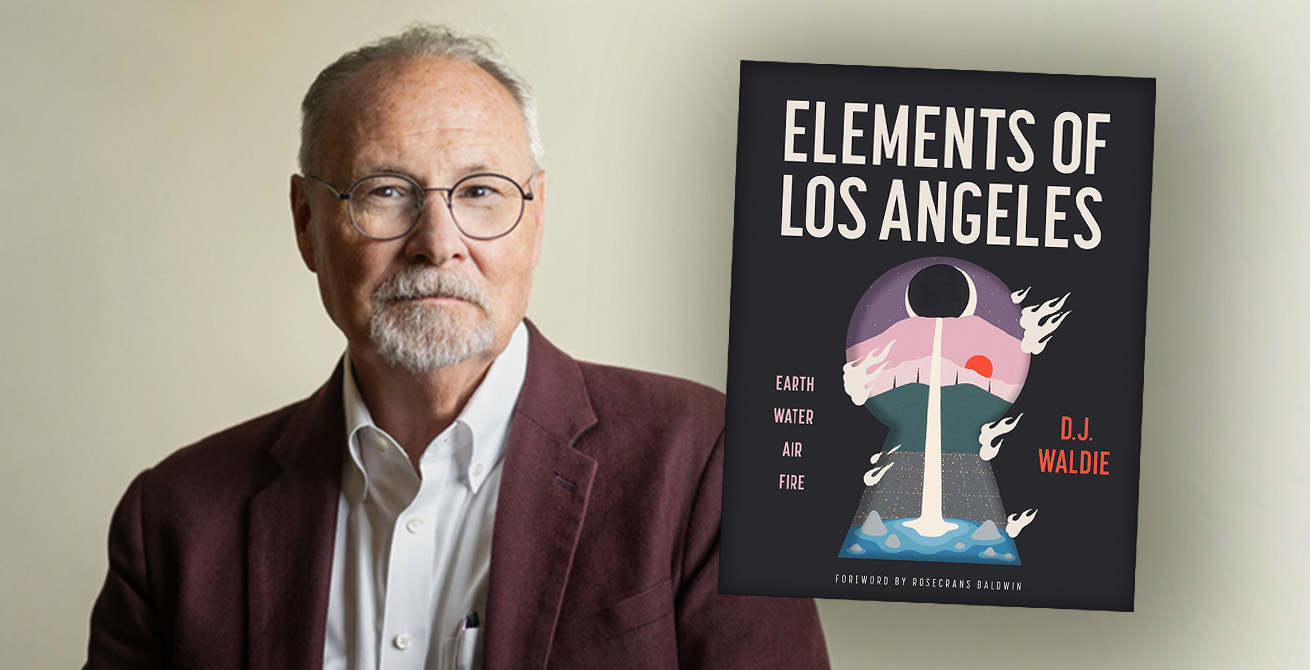
D.J. Waldie is a historian of Los Angeles, a memoirist, and a translator. He is the author of Holy Land: A Suburban Memoir (1995), Where Are We Now: Notes from Los Angeles (2005), Becoming Los Angeles: Myth, Memory, and a Sense of Place (2020), and other books about the culture and politics of Los Angeles. He is a contributing editor for the Los Angeles Review of Books. He was the recipient of the California Book Award for nonfiction in 1996, a Whiting Award in 1998, and the Dale Prize for Urban and Regional Planning in 2017. In books, essays, and commentary on urban issues, Waldie has sought to frame a sense of place for ordinary Angelenos. His latest book is Elements of Los Angeles: Earth, Water, Air, Fire and he recently talked about it with Daryl Maxwell for the LAPL Blog.
What was your inspiration for Elements of Los Angeles?
The immediate prompt came from Peter Lunenfeld. In his book City at the Edge of Forever: Los Angeles Reimagined (2020), Lunenfeld mused on the alchemical qualities of Los Angeles and showed me how the four classical elements could organize a multitude of the city's stories. His insight gave me the structure of this collection.
Much earlier, I had read Gaston Bachelard, the French phenomenologist. Bachelard explored the dimensions of imagination in its relationship to the sensory world. He is best known for The Poetics of Space (1958), a lyrical study of how we experience intimate spaces. He wrote what he called a "psychoanalysis" of the four classical elements (fire, water, air, and earth) and argued that these elements form the basis of our imaginative and emotional lives.
What was your process for putting together this collection? How did you decide, beyond being relevant to your elemental theme, which of your previously written essays/stories would be included (which of those might need revisions or updates)? Did you have ideas that you know would require something new?
Apart from aptness, I looked for essays that had connections to moments in the history of Los Angeles that linger in the present. (And by "Los Angeles," I mean that geographic and emotional space that includes the city and much of the county.) Finding the echoes of the past in the present is what I try to do. The pieces that fit that design needed only a modest amount of revision.
I didn't have a "water" story that paralleled those for the other three elements. I chose the St. Francis Dam disaster in 1928 because its lessons are even more relevant than those in the better-known story of the Owens Valley and the Los Angeles Aqueduct.
Were there any surprises as you reviewed your previous work (a piece that was a perfect fit, but you hadn't considered until you came across it)?
The essay on remembering the voice of Vin Scully was added late in the assembly of the book's parts. I realized I needed something to balance the essay on Sister Aimee and Fighting Bob Shuler and to reconnect to the moments of memoir that ground my work.
How did the collection evolve and change as you reviewed your previous work and wrote new pieces to include? Are there any essays that you hoped to include that you ultimately weren't able to in the published version?
I could have made a longer book with essays that have a greater distance from the thematic structure of the book. (I realize that readers may wonder how some of the essays that made the cut relate to one of the four elements. They all do to me.) I have a series of very short essays that riff on equally brief essays by a long-ago LA Times writer named Tim G.Turner. He wrote about places of memory in Los Angeles that were vanishing in the late 1930s. Each of Turner's essays was accompanied by a wonderful line drawing by Charles Owens. My reimagining of Turner's essays would have required the artworks, which might have been difficult to reproduce without the original drawings.
One of Turner's pieces was about a flower shop in Little Tokyo and its hidden Japanese garden. I regret I couldn't use my essay, updating that story in light of what happened in the Japanese American community only a few years after Turner's piece appeared in the Times.
How was Rosecrans Baldwin selected to provide the Foreword for Elements of Los Angeles? Had you worked with him before, or was there some other factor?
Rosecrans Baldwin and I had discussed Los Angeles in the past, most recently while he was writing Everything Now: Lessons from the City-State of Los Angeles. That book was Baldwin's up-to-the-moment survey of Los Angeles in 2021. He was my only choice to write a foreword. I'm glad that he found the time to add his words to mine.
You've done a lot of different types of work. You've written your own essay collections and provided essays to other collections and publications. You've written poetry, screenplays, and worked as a translator, and you've worked on exhibitions and exhibition catalogs. Is there a format of writing that you prefer over the others?
I think of myself as an essayist. The form is the one I'm most comfortable in. It allows for analysis and retrospection, for critique and musing, for anger and the lyrical pause.
Is there something you haven't done yet but are hoping to have the opportunity to try?
I've done work that doesn't make me wince in all the forms you've mentioned. I'm no journalist, however, so no celebrity interviews or first-person accounts of harrowing experiences are planned.
You were born in, and have lived your entire life, in Lakewood. Do you have any favorite places? A hidden gem that someone from another part of Los Angeles may not know about but should not miss?
Lakewood is about ordinariness. I once used the phrase "sacred ordinariness" in reference to the setting of my life. Lakewood doesn't impress or try too much either. It is a place wrapped well in the ordinary.
Similar question for Los Angeles proper. What are some of your favorite places in Los Angeles? Places that tourists would only learn about from a resident, and shouldn't miss, but often do?
Los Angeles (the city and the region) is almost too distracting. If you want more of Los Angeles, eat at its neighborhood joints like Jonathan Gold did to savor what nourishment Los Angeles offers to body and spirit. Hang around in some of the older neighborhoods—they may look a little noir—to find how the rhythms of life are carrying on in the material context of the city of 80 or 90 or 100 years ago. Go to the beach, a spectacle of what Southern California was supposed to be: bodies, sun, and sweet nothing to do. Spend an afternoon in a museum and enter a conversation with the past. Get out of your car and walk around.
If you could magically restore a location or two in Los Angeles that have been lost, what would it/they be?
It would be the Bunker Hill of the 1950s. Not a conventionally good place. Actually, a kind of lost place. But it was a remarkable multiethnic, multi-generational place. The same vitality of life was true of Boyle Heights in the 1930s and 1940s before the curse of freeway construction.
As I mentioned earlier, you've lived your entire life in Lakewood (you're living in the home where you were born!). Have you ever been tempted to move somewhere else (another part of Los Angeles, another part of California, another state, or another country)? If so, where did you consider moving to? If not, what is it about Lakewood that keeps you there?
I'm here for as long as age and circumstance permit. I've never felt the pull of elsewhere. Living here has given me a "long view" of my suburban life. Other writers have chosen differently and made a rich literature out of American itchiness to move on to bigger and brighter places. I've contributed to a minor literature of hanging around to see what happens next.
What's currently on your nightstand?
I don't have one. I never acquired the habit of reading in bed. Sleep is too wonderful to delay with a book.
Can you name your top five favorite or most influential authors?
Former LA Times Columnists
Jack Smith (chronicler of the everyday)
Jim Murray (sports columnist)
Poets
Gary Young: Young is known for his prose poetry.
Stéphane Mallarmé: Mallarmé (1842-1898) was a Symbolist poet and cultural critic.
Writers
Gaston Bachelard (1884–1962).
Stephen Jay Gould: Gould (1941–2002) was a paleontologist and science essayist.
Oliver Sacks: Sacks (1933–2015) was a neurologist, naturalist, historian of science, and writer.
John McPhee, perhaps our best writer of the long-form essay.
What was your favorite book when you were a child?
Ray Bradbury’s The Martian Chronicles.
Was there a book you felt you needed to hide from your parents?
I read a lot of "golden age" science fiction, not kept hidden but not flaunted either.
Is there a book you've faked reading?
Graduate school and the warring theorists of literature in the 1970s killed any passion I had for literary fiction. I haven't read the novels of the great names of the late 20th and early 21st century.
Can you name a book you've bought for the cover?
Can’t say I have.
Is there a book that changed your life?
Books changed my life. Reading of any sort—from cereal boxes to encyclopedias—changed my life.
Can you name a book for which you are an evangelist (and you think everyone should read)?
Bachelard's The Poetics of Space.
Is there a book you would most want to read again for the first time?
Jules Verne's 20,000 Leagues Under the Sea.
What is the last piece of art (music, movies, TV, more traditional art forms) that you've experienced or that has impacted you?
I listen to a great deal of orchestral music from every era. I'm often moved. I return again and again to the Hilbert Museum of American Scene painting in Orange, where the Southern California of the recent past is depicted with such beauty and with such knowing criticism. I reread the collections of prose poems by Gary Young. The light of Los Angeles occasionally breaks my heart.
What is your idea of THE perfect day (where you could go anywhere/meet with anyone)?
The temperature is about 75. There's a breeze with the smell of the Pacific coming from Alamitos Bay. Birds are wheeling overhead, even the annoying parrots who recently immigrated here. Light falls through the limbs and leaves of the street trees, making patterns on the sidewalk. People are out, strolling. People in pairs. There's a bar not too far ahead with a terrace open to the air. The wine is not too dear there. I'm thinking of something worth thinking.
What is the question that you're always hoping you'll be asked, but never have been?
Memoirs—with their invitation to reader voyeurism—invite all kinds of questions. I've been asked all of them more than once over the past 30 years. Unasked questions might dig into the area of belief and the daily practices of a life tethered—at least a little—to belief.
What is your answer?
Long ago in Holy Land: A Suburban Memoir, I commented on the experience of that kind of life and the narratives I used to describe it. I wrote, "When I walk to work, thinking of these stories, they seem insignificant. At Mass on Sunday, I remember them as prayer."
What are you working on now?
Writing is a business. I’m working on the book-selling part of it.
